 7450012800 / 033 24532800
 7450022800 / 7450062800
 medilink24x7@gmail.com
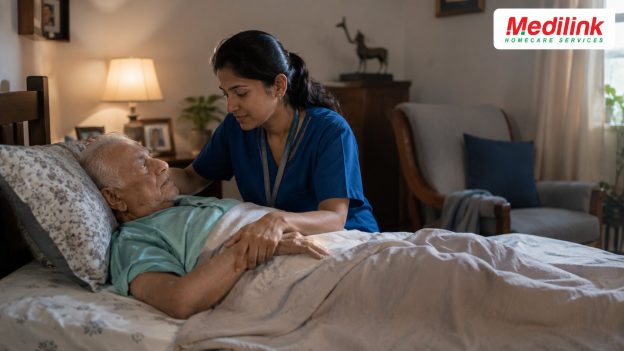
Content Summary:
Caring for a bedridden patient at home is physically demanding and medically complex. This guide explains what proper bedridden care involves, what complications families risk without professional support, and how Medilink’s trained nursing team helps families in South Kolkata manage it safely.
When someone you love becomes bedridden — whether after a stroke, a major surgery, a fall, or the slow progression of a chronic illness — the first few days feel like a blur.
Discharge papers. Medication schedules. Equipment you’ve never used before. A hospital bed delivered to a room that was never meant to be a medical space. And in the middle of all of it, a family trying to figure out: how do we actually do this?
Most families in Kolkata start by managing on their own. It comes from love, and it comes from the belief that nobody will care for a parent or spouse the way family will. That belief is true. But love alone cannot prevent a pressure sore. It cannot monitor oxygen saturation at 2 a.m. It cannot correctly reposition a 70-kilogram patient every two hours to prevent the complications that hospital nurses warn about but rarely explain.
If you have been searching for bedridden patient care near you, this guide is for you — not to sell you something, but to honestly explain what bedridden care requires, what happens when critical steps are missed, and what professional nursing support looks like when it is done right.
Why Bedridden Care Is More Medically Demanding Than Most Families Expect
A bedridden patient is not simply a person who cannot walk. They are a person whose entire body is affected by immobility.
Pressure sores — also called bedsores or decubitus ulcers — are the most well-known risk, and they develop faster than most families realise. Tissue damage can begin within two to six hours of unrelieved pressure on a bony surface. By the time redness appears on the skin, the damage underneath has often already spread. By the time the skin breaks, infection risk is significant.
But pressure sores are only one concern. Bedridden patients are also at high risk of chest infections, because lungs that are not regularly expanded through position changes accumulate secretions. Urinary tract infections are common, particularly in patients with catheters. Muscle contractures develop quickly in limbs that are not moved through their range of motion. And malnutrition creeps in when patients who are already unwell lose appetite and no one is monitoring their daily intake carefully.
The families we support at Medilink often tell us the same thing: they did not know how fast things could change. A patient who was comfortable on Monday had a reddened patch of skin on Wednesday that nobody caught. By Friday it had worsened into something that needed clinical attention.
This is not a failure of love or effort. It is the reality of caring for someone medically complex without clinical training.
What Professional Bedridden Patient Care Actually Involves
There is a difference between keeping someone comfortable and providing clinical care. Both matter, but they require different skills.
Repositioning and Pressure Care
Trained nurses follow a strict two-hourly repositioning protocol. This is not just turning someone from side to side — it involves correct positioning with pillows and wedges to completely offload pressure points like the heels, sacrum, and shoulders. It also involves skin inspection every time, checking for early-stage redness before it progresses.
Respiratory and Chest Care
Bedridden patients need regular head-of-bed elevation, and many benefit from chest physiotherapy techniques — percussion and postural drainage — to prevent secretion buildup. In patients with oxygen dependency, monitoring saturation levels and managing equipment correctly is a clinical responsibility, not something to be guessed at.
Catheter and Hygiene Care
Catheter management requires sterile technique to avoid infection. Personal hygiene for a bedridden patient — bed baths, oral care, hair washing, nail care — is not simply about dignity, though dignity absolutely matters. Neglected hygiene is a direct route to skin breakdown and infection. Our caregivers are trained to do this gently and completely, even for patients who are sensitive or resistant due to confusion or discomfort.
Nutrition and Hydration Monitoring
Many bedridden patients have swallowing difficulties, suppressed appetite, or require feeding through a nasogastric tube. A trained carer monitors daily food and fluid intake, watches for signs of dehydration, and coordinates with the treating physician when intake drops below acceptable levels.
Medication and Vitals
A bedridden patient typically has a complex medication schedule — multiple drugs, multiple timings, some of which cannot be delayed or missed. Vital sign monitoring (blood pressure, pulse, temperature, oxygen saturation) is done routinely because bedridden patients can deteriorate quietly. Catching a spike in temperature early or an unusual drop in blood pressure before it becomes a crisis is exactly what clinical oversight provides.
What Happens When Families Try to Manage Alone
We want to be direct about this, because families deserve honesty.
Caregiver burnout is not a weakness. It is a documented clinical outcome in family members caring for bedridden patients without professional support. The physical demands of repositioning, bathing, and lifting a full-grown adult, done multiple times a day every day, cause musculoskeletal injuries in a significant proportion of home caregivers. The sleep disruption alone — waking through the night to check on a patient — accumulates into a kind of exhaustion that affects judgment and emotional health.
We have had patients brought to our attention after weeks of family-only care where the signs were clear: bedsores that had progressed because no one knew what early-stage looked like, catheters that had not been changed on the right schedule, and patients who had lost significant weight because someone was estimating how much they had eaten rather than measuring it.
None of this happens because families do not care. It happens because bedridden care is a clinical skill that takes training to do safely.
How Medilink Supports Bedridden Patients in South Kolkata
Medilink has been serving families in Joka and South Kolkata for over a decade. Our nursing team is trained, verified, and supervised. When we place a nurse or caregiver with a bedridden patient, it is not a matchmaking exercise — it is the beginning of a structured care plan.
Our nursing care services for bedridden patients include:
- Full clinical assessment of the patient’s condition and existing care needs before the first visit
- Repositioning protocols with documented skin checks, every two hours for high-risk patients
- Wound care and bedsore management, from prevention through active treatment
- Catheter care and personal hygiene support with trained, dignified technique
- Vital sign monitoring and medication administration with proper documentation
- Nutrition monitoring and coordination with the treating physician when needed
- Regular family updates, so you always know how your loved one is doing and why
We cover Joka, Thakurpukur, Behala, Narendrapur, Garia, and the wider South Kolkata area. For families further away who are searching for bedridden patient care near them, we do a location check before confirming service — and in most cases, we can reach you.
We also understand that many families in this situation are managing finances carefully alongside everything else. We are transparent about pricing from the first call. No hidden charges, no ambiguity about what is included.
When Should You Call for Professional Help?
This is the question families sit with the longest. There is often guilt attached to it — a sense that calling for outside help means admitting defeat.
It does not. It means recognising what the situation requires.
You should consider professional bedridden patient care if any of the following applies:
- Your patient has been bedridden for more than a week and is not mobilising at all
- You have noticed any skin redness, particularly over the heels, tailbone, or hips
- Your patient has a catheter, feeding tube, IV line, or oxygen requirement at home
- You are the primary or only carer and you have not been sleeping properly
- Your patient is on multiple medications and you are not fully confident about the schedule
- Your patient’s eating or drinking has dropped noticeably in the past few days
Any one of these is enough reason to call. You do not need to wait until things get worse.
A Word to Families Who Are Doing This Alone
If you are currently the sole carer for someone bedridden — waking at night, managing medications, trying to reposition someone who outweighs you, skipping your own meals because there is no time — please read this.
You are doing something extraordinary. And it is also okay to say that you cannot keep doing it alone at the same level. These are not contradictory statements.
Getting professional nursing support does not take your place in that person’s life. It gives the clinical work to someone trained for it, so that you can be the daughter, the son, the spouse — the person your loved one actually needs you to be. That is not a small thing.
We have spoken to families who waited months before calling. Every one of them, without exception, said they wished they had called sooner.
Frequently Asked Questions
What is the difference between a caregiver and a trained nurse for a bedridden patient?
A caregiver — also called a patient attendant or ayah — provides personal care: bathing, feeding, companionship, and basic assistance with daily tasks. A trained nurse provides clinical care: wound management, catheter care, vital sign monitoring, medication administration, and identification of medical warning signs. Bedridden patients with medical equipment at home, existing bedsores, or complex medication needs require a trained nurse, not just a caregiver. Medilink assesses your patient’s specific needs and recommends the right level of support before any placement is made.
How often should a bedridden patient be turned or repositioned?
The standard protocol for high-risk patients is repositioning every two hours, around the clock. This is not a guideline — it is a clinical necessity. Tissue damage from pressure begins within two to six hours of sustained compression over a bony area. For patients who are incontinent or who have already developed early-stage redness, repositioning may need to happen more frequently, combined with moisture barrier creams and special mattresses. Our nurses follow written repositioning schedules with timed documentation, not guesswork.
Can Medilink provide bedridden patient care in areas outside Joka?
Yes. Our primary base is in Joka, South Kolkata, and we cover Behala, Thakurpukur, Narendrapur, Garia, Tollygunge, and surrounding localities. For families in other parts of Kolkata or nearby areas, please call us to confirm coverage before booking. We are expanding steadily and may be able to reach you even if your area is not listed here.
Does Medilink provide 24-hour nursing for bedridden patients?
Yes. For patients who need continuous clinical oversight — those on oxygen, those with active wound care needs, or those at high risk of sudden deterioration — we offer 24-hour live-in and rotating shift arrangements. Our 24/7 nursing plans are structured with documented handover between shifts, so nothing is missed at the transition point between caregivers. This is something families trying to manage alone often cannot replicate, and it is one of the most significant ways professional care improves patient outcomes at home.
About the Author
This article was written by the clinical care team at Medilink Healthcare Services, a trusted home healthcare provider based in Joka, South Kolkata. With over 10 years of experience and more than 1,500 patients served, Medilink’s nursing staff and care coordinators support bedridden patients, post-surgical recovery cases, and elderly care needs across South Kolkata — bringing clinical expertise directly to the home.