 7450012800 / 033 24532800
 7450022800 / 7450062800
 medilink24x7@gmail.com
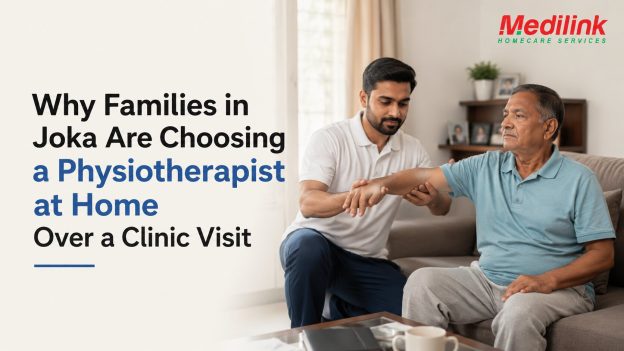
When a family member comes home after a knee replacement at AMRI Dhakuria or a stroke episode managed at a Behala nursing home, the discharge letter rarely prepares families for what comes next. The doctor says: continue physiotherapy. But the patient cannot sit in an auto for forty minutes each way. The stairs hurt. The family has work. And the nearest physiotherapy clinic in Joka closes by 8 PM.
This is the gap that home physiotherapy fills — and it is exactly why searches for a physiotherapist at home in Joka have increased steadily over the past two years. What was once considered a luxury or a last resort is now a practical, clinically sound choice for post-surgical recovery, stroke rehabilitation, and elder care in South Kolkata.
This guide is for families making that decision. It covers what home physiotherapy actually involves, which conditions are best served by it, what a proper session looks like, and how to tell a qualified therapist from someone with a foam roller and a certificate.
Who Actually Needs Physiotherapy at Home in Joka and Thakurpukur
The answer is broader than most families expect. Home physiotherapy is not only for bedridden patients. Across South Kolkata, the most common reasons families call for a home visit physiotherapist include:
- Post-operative recovery after knee replacement (TKR) or hip replacement — the first 6 to 8 weeks when the patient cannot safely travel daily
- Stroke rehabilitation — where early, consistent physiotherapy in the familiar home environment significantly improves functional recovery
- Fracture recovery — particularly in elderly patients with femur or wrist fractures who are non-weight bearing
- Neurological conditions such as Parkinson’s disease, where gait training and balance exercises are needed regularly
- Chronic back pain or cervical spondylosis in adults who work from home and cannot take repeated half-days for clinic appointments
- Post-Covid recovery — persistent breathlessness, muscle weakness, and fatigue that responds well to guided physiotherapy
- Geriatric care — elderly patients in Joka, Barisha, and surrounding areas who need regular mobility maintenance and fall prevention training
In most of these cases, the therapy is not different from what a clinic provides. The difference is that it happens on the patient’s own floor, with their own furniture as props, in a physical environment that actually mirrors what they will face every day during recovery.
What a Home Physiotherapy Session in South Kolkata Actually Involves
Families unfamiliar with home physiotherapy often expect a brief massage and a few arm circles. A proper home physio session from a qualified BPT-trained therapist is considerably more structured than that.
A first session always begins with a functional assessment: the therapist observes how the patient moves, stands, transfers from a chair, climbs a step, and manages basic daily tasks. For post-stroke patients, they assess grip strength, balance, and whether the affected limb has any returning function. For post-surgical patients, they check the wound for healing, measure range of motion with a goniometer, and assess pain levels with movement.
From that assessment comes a session plan. Depending on the condition, treatment techniques used in home visits include:
- Therapeutic exercises — progressive resistance and range-of-motion exercises designed for that patient’s stage of recovery
- Manual therapy — soft tissue mobilisation, joint mobilisation, and passive stretching performed by the therapist’s hands
- Electrotherapy — portable IFT (Interferential Therapy) and TENS machines that a qualified therapist brings along for pain relief and muscle stimulation
- Gait training — structured walking practice with or without an assistive device, using the patient’s own home layout
- Neuromuscular re-education — for stroke patients, this includes task-specific practice of daily movements to rebuild neural pathways
- Home exercise prescription — exercises the patient and family member perform between visits, with clear guidance on sets, repetitions, and warning signs
A genuine session lasts between 45 minutes and an hour. It is not a 20-minute comfort visit. If a therapist is regularly finishing in under thirty minutes, that is a quality signal worth noting.
What to Check Before Hiring a Home Physiotherapist Near Joka or Behala
South Kolkata has a large number of practitioners offering home physio visits. Not all of them hold a Bachelor of Physiotherapy (BPT) degree, which is the minimum qualification for independent practice in India. Some hold diploma certificates or short courses, which are insufficient for managing post-surgical or neurological cases.
Before confirming a therapist, families should ask the following:
- Do they hold a BPT degree from a recognised university? Ask which institution and check if it is recognised by the Indian Association of Physiotherapists (IAP).
- Do they have MIAP or FIAP membership? These indicate professional standing with the IAP, which has a registered member directory.
- Have they managed similar cases before? A therapist experienced in post-TKR recovery may have limited neurological training. Ask specifically about their case history.
- Do they carry portable equipment? A therapist without at minimum a TENS machine and a goniometer is not equipped for thorough home treatment.
- Can they communicate with the treating orthopaedic surgeon or neurologist? This coordination matters for cases where the therapy plan needs to align with surgical advice.
In areas like Joka, Thakurpukur, and Barisha, there are qualified registered physiotherapists who do home visits. The Sulekha and Practo platforms list some of them with ratings. But direct verification of qualifications remains the responsibility of the family.
When Home Physiotherapy Is Clinically Better Than a Clinic Visit
The instinct of many families is to assume a clinic is always more thorough. In reality, for several common conditions in elderly and post-surgical patients, home physiotherapy produces better outcomes — and there are specific reasons for this.
First, the therapy happens in the actual environment of recovery. A post-stroke patient learning to walk in a clinic corridor is practising in a space with no relevance to their daily life. The same patient practising transfers from their own bed, navigating the small bathroom at the end of their corridor, and climbing the two steps at their front door — that is therapy that directly reduces fall risk at home.
Second, consistency is higher at home. The evidence on physiotherapy adherence is clear: patients who miss sessions lose ground. For a seventy-year-old in Joka who needs a family member to accompany them to a clinic, the friction of each visit means skipped sessions are common. A therapist who comes to the house removes that barrier completely.
Third, family members are present and can be trained. A caregiver who watches a session and understands the exercise rationale will continue reinforcing correct movement throughout the day. This caregiver involvement is almost impossible to replicate in a busy clinic environment.
Home physiotherapy is not always the right choice. For patients who need hydrotherapy, advanced electrotherapy equipment, or group rehabilitation settings, a clinic or inpatient rehabilitation centre like the HCAH facility near Chak Garia is more appropriate. But for the large proportion of recovery cases in South Kolkata — post-surgical orthopaedic recovery, stroke rehabilitation, and elderly mobility maintenance — home visits are clinically and practically well suited.
Realistic Recovery Timelines for Common Conditions in Home Physiotherapy
One of the most common frustrations families experience is misaligned expectations. Either they expect recovery too fast and stop sessions too early, or they worry progress has stalled when the timeline is actually normal.
For post-knee replacement rehabilitation, the initial phase of reducing swelling, achieving 90 degrees of knee flexion, and building enough quadriceps strength to climb stairs safely typically takes 6 to 8 weeks of consistent home physiotherapy — usually 4 to 5 sessions per week in the first three weeks, tapering to 3 sessions per week thereafter.
For stroke rehabilitation, the highest rate of neurological recovery occurs in the first 3 to 6 months. Physiotherapy during this window — ideally starting within days of discharge — is critical. Families in Joka who delay starting home physio for even two to three weeks after discharge reduce the functional gains their relative can achieve. The window is not closed after 6 months, but it does narrow.
For chronic back pain or cervical spondylosis, the goal of home physiotherapy is not cure but management and functional improvement. A structured 12-session programme over 6 weeks, followed by a home exercise programme the patient continues independently, is a realistic and achievable outcome.
For general elderly mobility maintenance, physiotherapy is ongoing rather than time-limited. Regular sessions every 1 to 2 weeks, focused on balance, strength, and gait, can materially reduce fall rates — which is one of the leading causes of decline in elderly patients in South Kolkata.
The Specific Situation in Joka, Thakurpukur, and Behala
South Kolkata has a dense and aging residential population spread across areas like Joka, Barisha, Thakurpukur, Behala Chowrasta, Sarsuna, and Paschim Putiary. Many of these neighbourhoods are a significant distance from the major rehabilitation hospitals in central Kolkata. Daily travel to physiotherapy is not realistic for a large proportion of post-surgical or elderly patients in these areas.
At the same time, local physiotherapy clinics in Joka and Thakurpukur — including Physio Care on BH Road and several registered practitioners listed with the IAP West Bengal Branch — provide strong community-level options for patients who can travel. Home physiotherapy complements these services, covering patients who cannot.
Families caring for post-surgical or neurologically compromised relatives in these areas are often making do with informal arrangements. A nephew drives the patient three times a week, the therapy gets missed when he is travelling, and the recovery stalls. The logistics problem is often what delays proper rehabilitation — not the patient’s clinical condition or the family’s willingness to invest in recovery.
Getting Qualified Home Physiotherapy in South Kolkata
If you are caring for a family member who needs regular therapy sessions but cannot travel consistently, the right starting point is to find a BPT-qualified therapist with relevant case experience who covers your area. Assess their qualifications, ask for a brief consultation before committing, and ensure they have a structured session plan — not just a comfort visit routine.
Medilink Healthcare Services provides qualified physiotherapy and rehabilitation service in home for patients across Joka, Thakurpukur, Behala, and surrounding South Kolkata areas. Sessions are conducted by registered physiotherapists, coordinated with the patient’s treating physician, and designed around the actual demands of home-based recovery.
Frequently Asked Questions
How soon after surgery can home physiotherapy begin?
For most orthopaedic surgeries including knee and hip replacement, home physiotherapy can begin within 3 to 5 days of discharge, once the wound is stable and the patient is cleared by the surgeon. For stroke, it should begin as early as the first week home. Earlier is almost always better.
What equipment does a home physiotherapist bring?
A well-equipped home physiotherapist carries a portable TENS or IFT unit for pain relief and muscle stimulation, a goniometer for measuring joint range of motion, resistance bands, and any exercise props relevant to your condition. Ultrasound therapy machines are occasionally brought for specific musculoskeletal conditions.
How many sessions per week are typically needed?
Post-surgical patients generally need 4 to 5 sessions per week in the first 2 to 3 weeks, reducing to 3 per week as the recovery stabilises. Stroke patients benefit from daily sessions in the acute recovery phase if possible. Elderly mobility maintenance typically needs 1 to 2 sessions per week.
Does insurance cover home physiotherapy?
Some health insurance policies in India do cover post-surgical physiotherapy as part of a hospitalisation package or a post-discharge benefit. Check your policy document under the rehabilitation or post-hospitalisation clause. Coverage for standalone home physio visits varies significantly by insurer.
Is a home physiotherapist able to handle neurological cases like stroke or Parkinson’s?
Yes, provided the therapist has neurological physiotherapy training. Always ask specifically about their experience with neuro cases before booking. A therapist with only orthopaedic experience may not be equipped for the specific techniques required in stroke or Parkinson’s rehabilitation.
Can a family member be trained to assist between sessions?
Yes, and a good therapist will actively involve the primary caregiver in each session. They will demonstrate the home exercises, explain the rationale, and set clear boundaries on which exercises can be done independently and which need therapist supervision. This caregiver training is one of the key advantages of home physiotherapy over clinic visits.
About Medilink Healthcare Services
Medilink Healthcare Services is a home healthcare provider based in Joka, South Kolkata, serving families across Joka, Thakurpukur, Behala, Barisha, and surrounding areas. The Medilink team includes trained nurses, physiotherapists, and care attendants who deliver clinical home care services under physician guidance. Content published on this blog is reviewed for clinical accuracy and reflects the service context of South Kolkata’s home healthcare environment.