 7450012800 / 033 24532800
 7450022800 / 7450062800
 medilink24x7@gmail.com
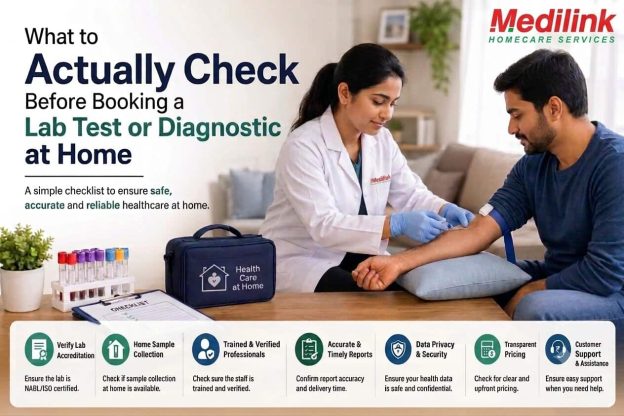
A few months ago, a health-industry report on the at-home blood test boom in India described something we hear echoes of often in our own work: a man booked an at-home blood test for his elderly parents, the results flagged pre-diabetes, and the family spent days worried before a follow-up test at a proper lab showed both parents were completely healthy. The difference wasn’t the equipment. It was how the sample was handled between the needle and the machine.
We bring this up because it’s the exact question families in Joka, Behala, and Thakurpukur ask us most before booking a home lab test: is it actually as reliable as going to a lab in person? Most articles on this topic answer with a flat “yes, it’s just as accurate” and move on. We think that’s an incomplete answer, and an unhelpful one if you’re the person deciding whether to trust a test result about your parent’s kidney function or blood sugar.
Why Home Sample Collection Has Become the Default for So Many Families
We’ve watched the shift happen firsthand over the past few years. Families managing an elderly parent’s diabetes or hypertension used to build entire mornings around a lab visit — waking someone up early for a fasting test, arranging transport, waiting in a queue with other patients. For a parent recovering from surgery or living with limited mobility, that trip alone can undo the point of the test.
Home collection removes that friction. A trained phlebotomist comes to you, draws the sample in a familiar, one-on-one setting, and the person being tested never has to leave their bed. For infants, for someone immunocompromised, or for an elderly patient who tires easily, that matters as much as the result itself.
Where Home Test Accuracy Can Actually Go Wrong
Here’s the part most home-testing companies skip over, and it’s worth being direct about it: the sample collection itself isn’t where accuracy problems usually come from. It’s everything that happens after the needle comes out.
Sample handling and transport time
Blood isn’t stable once it leaves the body. Certain components start to change within minutes if the sample sits at the wrong temperature or takes too long to reach the lab. A rushed pickup, a delay in traffic, or a vial left in a hot bag can quietly skew a result before it’s ever run through a machine.
Tests that are especially sensitive to this
Not every test is affected equally. A few are known to be particularly sensitive to handling delays:
· Potassium — levels can shift if red blood cells break down during transport, which matters enormously for anyone with kidney disease
· Glucose — blood sugar readings can drop the longer a sample sits before processing, which is exactly how a healthy person can end up with a false pre-diabetic reading
· Complete Blood Count (CBC) — cell counts can change if the sample isn’t processed within the recommended window
None of this means home testing is unreliable. It means the protocol between collection and the lab is what determines reliability, not the setting.
What We Check Before Every Home Sample Collection
This is the part that doesn’t usually make it into a home-testing FAQ, but it’s what we treat as non-negotiable for every visit we make:
· Our phlebotomists are certified and trained specifically in home-based draws, not just clinic settings
· We use the same sealed, single-use vacutainers used in accredited labs — never open-vial collection
· Samples go into a temperature-controlled kit immediately, and we track transport time so nothing sits longer than it should
· Every sample is processed through an NABL-accredited partner lab, the same standard a hospital lab would use
· Reports are cross-checked before they’re released, and anything unusual gets flagged for a doctor’s review rather than sent out as a raw number
We mention all of this not to sell the process, but because a family deciding whether to trust a result deserves to know what’s actually happening between the visit and the report landing in their inbox.
Why a Lab Test Means More When It’s Part of Ongoing Care
This is where we’d push back gently on how most diagnostic apps frame home testing — as a single transaction. Book a test, get a report, done. For a family managing an elderly parent’s chronic condition, a lab result in isolation isn’t very useful. What matters is whether someone is actually looking at it in context.
When we run a lab test for a patient we’re already caring for — someone on our chronic disease management program, or recovering under post-surgery care — the result doesn’t just get emailed and forgotten. It gets compared against their last three reports, flagged if something’s trending the wrong way, and shared with the doctor coordinating their care. A single potassium reading means very little on its own. The same reading next to six months of history means a great deal.
That continuity is genuinely hard to replicate with a one-off app booking, and it’s the biggest reason we’d encourage families to think about lab testing as part of a broader care relationship rather than a standalone errand, especially for elderly parents managing more than one condition at a time — which is also why this ties closely into our elderly care and geriatric support services.
A Quick Checklist Before You Book Any Home Lab Test
If you’re evaluating any provider, not just us, these are the questions worth asking:
· Is the partner lab NABL-accredited?
· Are the phlebotomists trained and certified specifically for home collection?
· What’s the sample transport protocol, and how long does it typically take to reach the lab?
· Will a doctor review the results, or do you just receive a PDF with no context?
· If a result looks unusual, is there someone you can actually call?
A provider that can answer all five clearly is one worth trusting with a parent’s blood sample.
How We Handle This Across South Kolkata
We run home sample collection across Joka, Thakurpukur, Behala, and the surrounding areas as part of our regular home healthcare visits, not as a separate side service. Whether it’s a routine panel for someone on our chronic disease management program or a one-time test a family needs before a doctor’s appointment, the same protocol applies every time — certified phlebotomists, accredited lab partners, and a report that goes to a doctor’s eyes, not just an inbox.
If you’re weighing whether to get a parent’s blood work done at home, we’re happy to walk you through exactly how the process works before you book anything.