In Kolkata, healthcare decisions are slowly changing. For years, most families followed a fixed approach—if someone fell seriously ill, they were admitted to a hospital and stayed there until recovery. It felt like the safest option, and in many cases, it still is.
But over time, especially after recent years, people have started to question whether every stage of recovery really needs to happen inside a hospital. In areas like Joka, Thakurpukur, and Behala, this thought is becoming more common, not because people are avoiding hospitals, but because they are trying to find a more practical balance.
What many families are realizing is that treatment and recovery are not always the same thing. Hospital care is essential during critical stages, but once the situation stabilizes, the need often shifts toward monitoring, support, and consistency. This is where the role of home healthcare services in Kolkata has started to become more visible in everyday conversations.
This change did not happen overnight. It came from experience. During the pandemic, when hospital beds were limited and movement was restricted, families had no option but to manage care at home. Guidelines from organizations like the World Health Organization and India’s National Health Authority supported monitored home care in specific cases. That period made people more aware of what could actually be managed outside hospital walls.
Looking at the Reality of Hospital Stays
Anyone who has managed a hospital stay in Kolkata understands how demanding it can be. The cost increases quickly, especially if the stay extends beyond a few days. Along with that, there is the constant activity, shared attention, and the challenge of coordinating everything around the patient.
For elderly individuals, the situation becomes more complicated. Being in an unfamiliar place for a long time often leads to discomfort or restlessness. Medical observations available through the National Center for Biotechnology Information also suggest that recovery is influenced not just by treatment, but by environment and mental comfort.
A Situation Many Families in Joka Understand
A family in Joka recently went through a situation that reflects what many others are experiencing. An elderly member had undergone a procedure and was discharged with instructions for careful monitoring, medication, and daily assistance.
At first, the family thought about extending the hospital stay, just to be on the safe side. But the environment was not comfortable for the patient, and the cost was becoming difficult to manage. They eventually decided to continue care at home with structured support.
Within a short time, the difference became clear. Daily routines were better managed, medication was given on time, and the patient felt more relaxed. The family, too, found it easier to handle their responsibilities without constant disruption.
This is not an isolated experience. Similar situations are becoming increasingly common across South Kolkata.
Why the Shift Feels Practical
The growing preference for home-based care is not based on emotion alone. It is a response to real challenges that families face every day. Managing work, travel, and patient care together is not easy, especially in a busy city.
At home, care becomes more consistent. The patient is in a familiar space, and support can be arranged in a way that fits the family’s routine. Instead of adjusting everything around hospital schedules, care adapts to daily life.
This balance is what many families are looking for.
Recovery Beyond Medical Treatment
Recovery is often seen only as a medical process, but there is more to it. Emotional comfort, routine, and familiarity all play a role in how a patient responds over time.
When patients are at home, they are surrounded by known environments and people they trust. This reduces stress and helps maintain a sense of normalcy. For elderly patients in particular, this can make a noticeable difference in how they recover.
It does not replace medical care, but it supports it in a way that hospitals cannot always provide.
A Gradual Change Across Kolkata
Across Kolkata, especially in areas like Joka and Thakurpukur, this shift is becoming more visible. Families are not moving away from hospitals, but they are using them differently. Critical treatment still happens there, but recovery is increasingly being managed at home.
This approach is more flexible and often more aligned with real-life needs. As awareness grows, more people are becoming open to this idea.
Final Thoughts
Healthcare is slowly adapting to the way people live today. It is no longer limited to one place or one approach.
For many families in Kolkata, especially in Joka and nearby areas, continuing care at home is becoming a practical decision rather than an uncertain one. It allows them to manage both health and daily life in a more balanced way.
As this shift continues, the importance of reliable home healthcare services in Kolkata will only increase. Choosing the right support system becomes an important part of that process.
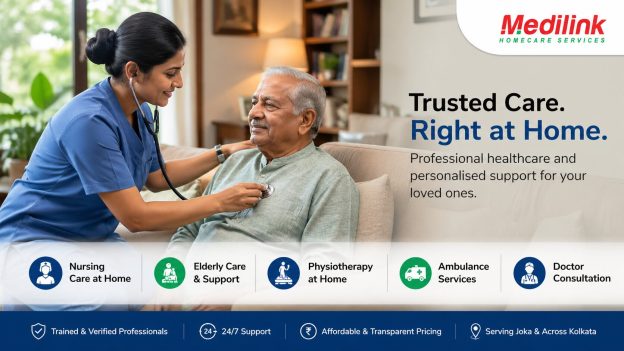
Among the providers working in this space, Medilink Healthcare Services is one of the names supporting families with structured home care and healthcare services across South Kolkata.