 7450012800 / 033 24532800
 7450022800 / 7450062800
 medilink24x7@gmail.com
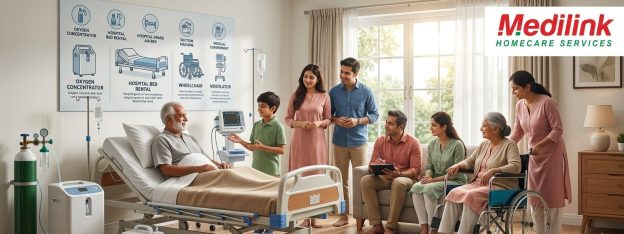
Content Summary: This post is written for families in Joka, Behala, Thakurpukur, and surrounding South Kolkata areas who are caring for a recovering or elderly patient at home. It draws on Medilink Healthcare’s firsthand experience in home-based medical equipment rental and sales to explain what equipment is most commonly needed, how the rental process actually works, what families often get wrong, and why professional guidance matters. The post is practical, reassuring, and grounded in the realities of South Kolkata home care.
The call usually comes without warning. A parent is being discharged from AMRI or SSKM. The doctor has said the patient needs a hospital bed at home, an oxygen concentrator running through the night, and a wheelchair for short distances. It is four in the afternoon. Discharge is tomorrow morning.
In that moment, most families in Joka, Behala, or Thakurpukur have no idea where to start.
This post is written for exactly that situation. Not for a calm, planned research exercise — but for a family that needs clear, trustworthy guidance quickly. Over the years, the Medilink Healthcare team has worked with hundreds of families across South Kolkata in precisely this position. What follows is what we tell them.
Why Renting Makes More Sense Than Buying for Most Families
The instinct when a family member is unwell is often to purchase equipment outright. It feels more permanent, more committed. But for the majority of home care situations — post-surgery recovery, short-term respiratory support, fracture rehabilitation — the patient will not need that equipment indefinitely.
A hospital bed costs anywhere from ₹15,000 to ₹40,000 to purchase. An oxygen concentrator runs ₹30,000 to ₹80,000 depending on the model and flow rate. For a recovery that may last six to twelve weeks, renting the same equipment costs a fraction of that — and when the patient no longer needs it, the equipment goes back. No storage problem. No resale headache.
There is also a clinical advantage to renting through a professional provider. At Medilink, every piece of equipment we send to a patient’s home has been serviced, sanitised, and function-tested before dispatch. A family purchasing second-hand equipment from an unknown source has no such guarantee. In medical equipment, that difference is not trivial.
The exception is long-term or chronic care. Patients with permanent mobility limitations, chronic respiratory conditions like COPD, or long-term neurological needs often benefit from purchasing equipment they will use daily for years. We assess this with families individually — and our medical equipment rental and sales service covers both options so families are never locked into one approach.
What Equipment Is Most Commonly Needed in South Kolkata Homes
The profile of home care in South Kolkata has some specific characteristics. This part of the city has a large, established elderly population, a high density of residential housing with variable floor layouts, and a significant number of families managing post-surgical or post-hospitalisation recovery at home rather than in nursing facilities.
Based on our experience serving families across Joka, Behala, New Alipore, Thakurpukur, and Garia, the most common equipment requests we handle are:
Hospital Beds
An adjustable hospital bed is the foundation of effective home care for a bedridden or semi-mobile patient. It allows the head and foot of the bed to be raised independently, which matters enormously for patients recovering from abdominal surgery, heart conditions, or stroke. Manual beds are available at lower rental rates; electrically adjustable beds offer more comfort for patients who need frequent position changes. We help families assess which type is appropriate based on the patient’s condition and the caregiver’s capacity.
Oxygen Concentrators and Cylinders
Oxygen support at home is one of the most frequent requests we receive — particularly following respiratory illness, cardiac events, or post-COVID recovery. An oxygen concentrator draws in room air and delivers purified oxygen continuously without requiring cylinder refills, making it the preferred option for home use. We set up the equipment, demonstrate correct usage to the family, and remain available if any issue arises during the rental period. For short-duration or transport use, cylinders are also available.
Wheelchairs and Walkers
Mobility aids are needed across a wide range of situations — from elderly patients with arthritis or balance issues to younger patients recovering from orthopaedic surgery. We assess the patient’s weight, the width of doorways in their home (a genuine issue in older South Kolkata buildings), and the nature of movement required before recommending the right wheelchair type. Folding transit wheelchairs, self-propelled models, and specialised reclining chairs are all available.
BiPAP and CPAP Machines
Respiratory therapy equipment is increasingly requested for home use — both for sleep apnoea management and for patients with chronic breathing conditions requiring non-invasive ventilation support. These devices require careful initial setup and user training. Our team handles both.
Air Mattresses and Pressure-Relief Equipment
For patients who are bedridden for extended periods, pressure sore prevention is a clinical priority. An air mattress alternates pressure points continuously, dramatically reducing the risk of skin breakdown. We consider this essential for any patient spending more than a few days in bed and routinely recommend it alongside hospital bed rentals for post-surgical or post-stroke patients.
How the Rental Process Works at Medilink
We have deliberately kept our process simple, because families dealing with a medical situation do not need administrative complexity on top of everything else.
A family contacts us — by phone, by WhatsApp, or through our website. We ask a few basic questions: the patient’s condition, the equipment needed, the location, and the expected duration. Based on this, we recommend the appropriate equipment, explain the rental cost clearly with no hidden charges, and confirm availability.
We deliver to the patient’s home, set up the equipment properly, and walk the family through how to use it safely. This demonstration step is not optional for us — it is part of every delivery. A family managing a BiPAP machine or an oxygen concentrator for the first time needs to understand exactly what they are looking at.
During the rental period, we remain in contact. If something is not working correctly, if the patient’s condition changes and different equipment is needed, or if the rental period needs to be extended or ended early, we handle it. The relationship does not end at delivery.
Our service area covers Joka, Behala, Thakurpukur, New Alipore, Garia, Jadavpur, and surrounding South Kolkata localities. For urgent requests — and many of ours are urgent — we prioritise same-day or next-morning delivery wherever possible.
What Families Often Get Wrong
In our years of working with home care patients across South Kolkata, a few patterns come up repeatedly — not because families are careless, but because nobody has told them what to watch for.
The first is choosing equipment based on price alone. A lower-cost oxygen concentrator that delivers inconsistent oxygen purity, or a hospital bed with a mattress that does not properly support a bedridden patient, can genuinely worsen outcomes. We always explain the clinical trade-offs, not just the price.
The second is underestimating the importance of the mattress. Most families focus on the bed frame and treat the mattress as secondary. For a patient spending significant time in bed, the mattress determines whether pressure injuries develop. We never separate the two in our recommendations.
The third is not telling us enough about the home environment. South Kolkata has a mix of older narrow-corridor housing and newer apartment buildings. The right wheelchair for a patient in a ground-floor house with wide doorways is different from the right wheelchair for a patient on the fourth floor of a building with a narrow lift. We need to know the home before we recommend the equipment.
When Professional Guidance Changes the Outcome
There are situations where the right equipment alone is not enough — and where clinical guidance at the point of setup genuinely matters.
A patient newly discharged after a cardiac event, now requiring oxygen at home, needs someone to explain what oxygen saturation reading should prompt a call to the doctor. A family managing a post-stroke patient needs to understand safe positioning to avoid aspiration. These are not equipment questions — they are care questions. But they arise in the context of equipment setup, and they require someone with clinical training to answer them.
At Medilink, our team includes trained healthcare professionals alongside our equipment service. When we deliver and set up at a patient’s home, the person doing that setup understands the clinical context — not just the technical operation of the device. That is the difference between a rental company and a healthcare provider.
A Note From Our Team
We are based in Joka and serve the communities around us — Behala, Thakurpukur, New Alipore, Garia, and further across South Kolkata. We started with a clear conviction: families managing a patient at home should never feel alone in that process, and they should never have to figure out clinical equipment without proper guidance.
If you are in the early stages of planning home care for a family member, or if you have been told a patient will be discharged shortly and you are not sure what to arrange, reach out to us. We will listen first, and then help you make the right decisions.
At Medilink Healthcare, we treat every equipment request as a care request — because that is what it always is.
Frequently Asked Questions
Can I rent medical equipment in Joka or Behala on the same day?
For most commonly needed equipment — hospital beds, oxygen concentrators, wheelchairs — same-day delivery is available within our South Kolkata service area, subject to availability. We prioritise urgent post-discharge requests. Call us as early as possible to confirm.
How is rented medical equipment sanitised before delivery?
Every piece of equipment at Medilink is cleaned and disinfected between uses using hospital-grade sanitisation procedures. For respiratory equipment like oxygen concentrators and BiPAP machines, we also function-test the device before dispatch to verify it is operating within correct parameters.
What is the minimum rental period for a hospital bed or oxygen concentrator?
We offer flexible rental plans starting from a weekly basis, with lower effective rates for monthly or longer-term rentals. We do not lock families into fixed long contracts — if the patient recovers ahead of schedule and no longer needs the equipment, we arrange early return without penalty.
Is it better to rent or buy a wheelchair for an elderly parent?
It depends on the patient’s prognosis and long-term mobility outlook. For short-term recovery, renting is almost always more practical and cost-effective. For a patient with a permanent or progressive mobility limitation, purchasing a wheelchair that is properly fitted to their measurements and usage pattern is often the better long-term decision. We help families think through which situation applies.
Do you provide training on how to use the rented equipment at home?
Yes — without exception. Every delivery includes a hands-on demonstration for the patient’s family or caregiver. For equipment like oxygen concentrators, BiPAP machines, and patient monitors, we cover both correct operation and what to watch for clinically. We also remain available by phone throughout the rental period if any question arises.
About the Author
This article is written by the clinical and care coordination team at Medilink Healthcare Services, a home healthcare provider based in Joka, South Kolkata. Medilink has been supporting families across the Joka, Behala, Thakurpukur, and Garia areas with professional home nursing, physiotherapy, elderly care, and medical equipment rental and sales. Every recommendation in this post comes from direct experience working with patients and families in their homes.