 7450012800 / 033 24532800
 7450022800 / 7450062800
 medilink24x7@gmail.com
Content Summary
This guide explains what home oxygen therapy involves, who needs it, and how families in Joka and nearby South Kolkata areas can manage it safely and with confidence. It covers the most common caregiver concerns — from equipment use and safety rules to emotional support — and outlines how professional home healthcare support can make a meaningful difference in outcomes and daily quality of life.
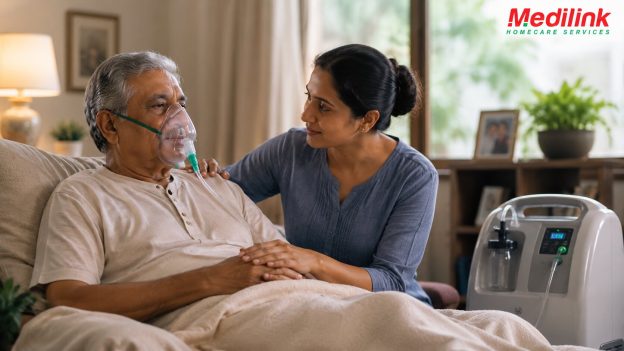
When a doctor tells a family that their elderly parent needs oxygen at home, the first reaction is rarely calm. There is the worry about whether you will do it right, the fear that something will go wrong in the middle of the night, and the very practical question of how daily life is supposed to continue with an oxygen concentrator sitting in the bedroom and tubes running across the floor.
These are the questions that real caregivers in Joka, Narendrapur, Diamond Harbour Road, Maheshtala and other parts of South Kolkata are asking — often quietly, because there aren’t many places that give them an honest, useful answer. This guide is an attempt to do exactly that.
Oxygen support at home, done well, allows patients with serious respiratory conditions to live with more dignity and more comfort than a hospital setting often permits. Done poorly — or without proper guidance — it carries real risks. Understanding the difference starts here.
Who Needs Oxygen Support at Home?
Home oxygen therapy is typically prescribed when a patient’s blood oxygen saturation consistently falls below the level needed for the body to function normally — usually measured as an SpO2 reading below 90% at rest. A doctor or pulmonologist makes this call based on clinical assessment; it is never a decision to make independently.
The most common conditions that lead to a home oxygen prescription in India include:
- Chronic Obstructive Pulmonary Disease (COPD) — the most frequent cause among older patients in South Kolkata, often linked to decades of exposure to cooking smoke, vehicular pollution, or tobacco
- Interstitial lung disease and pulmonary fibrosis — progressive conditions that gradually reduce the lungs’ ability to transfer oxygen
- Post-COVID lung complications — a condition many families in Kolkata are now navigating following severe infections in recent years
- Advanced heart failure — where the heart’s reduced pumping ability leads to poor oxygen delivery
- Severe anaemia or recovery from major surgery — where supplemental oxygen supports healing and reduces cardiac strain
In Joka and the surrounding areas of Diamond Harbour Road, Thakurpukur, and Behala, where elderly residents often have limited access to hospital-based respiratory care, home oxygen setup has become an important part of managing these conditions long-term.
Understanding the Equipment: What Will Be in Your Home
Most families have never dealt with medical oxygen equipment before. The unfamiliarity itself is a source of anxiety. Knowing what each piece does makes the whole setup far less intimidating.
Oxygen Concentrator
This is an electric device, roughly the size of a bedside table, that draws in room air and filters out nitrogen to deliver concentrated oxygen through a nasal cannula. It runs continuously and does not require cylinder refills, making it the preferred choice for long-term home use. In Kolkata, where power fluctuations are common, a stabiliser or UPS backup is an important companion to the concentrator.
Oxygen Cylinders
Used as a backup during power cuts or when the patient needs to move briefly — a short trip to a clinic, for example. A standard D-size cylinder at 2 litres per minute lasts roughly five to six hours. Cylinders must be stored upright, away from heat sources, and should never be allowed to empty completely before replacement.
Nasal Cannula and Mask
The nasal cannula — a lightweight tube with two small prongs that sit just inside the nostrils — is the most common delivery method for lower-flow oxygen. For patients who need higher concentrations, a face mask may be used. Both need to be checked regularly for fit, cleaned daily, and replaced periodically to prevent infection and skin irritation around the nose and ears.
Pulse Oximeter
A small clip-on device that reads blood oxygen saturation levels through the fingertip. Every family managing home oxygen therapy should own one and know how to use it. A reading consistently below 90% at rest, or below 88% during activity, is a signal to contact the treating doctor promptly.
The Safety Rules That Cannot Be Skipped
Oxygen accelerates combustion. A room where oxygen is in use requires specific precautions, not as bureaucratic formality, but because the risks are real and the consequences severe.
- No smoking — anywhere in the home, not just in the patient’s room. This is the most important rule and the one most frequently violated in Indian households where family members smoke.
- No open flames — candles, agarbatti, gas stoves should not be used near an active oxygen source. In Kolkata homes where cooking happens in close quarters, the concentrator placement matters.
- No oil-based products near the face — Vaseline, coconut oil, and other petroleum-based products are flammable and should never be applied around the nose or lips of a patient on oxygen. Use water-based moisturisers only.
- Maintain distance from electrical equipment — the concentrator generates mild heat and should have clear airflow around it, kept at least 30 cm from walls and curtains.
- Check tubing daily — kinked or cracked tubes reduce oxygen delivery without triggering any alarm. A daily visual check takes under a minute and matters more than most people realise.
What Caregivers Actually Worry About — And What Helps
After years of supporting families through home oxygen setups in South Kolkata, the concerns we hear most often are not technical. They are human.
“What if the machine stops working at night?”
Always have a backup cylinder charged and ready. Know your equipment provider’s emergency contact. A basic alarm or monitoring setup can alert caregivers to any interruption. And if a 24/7 caregiver or nurse is in place, this worry largely resolves itself.
“How do I know if the oxygen level is right?”
The flow rate is set by the prescribing doctor and should never be adjusted without medical guidance — even if the patient feels short of breath. A pulse oximeter reading, logged twice daily, gives a reliable picture of how the patient is responding to therapy. Consistent readings above 92–94% at rest usually indicate the prescribed flow is working.
“Our patient refuses to wear the cannula for long periods.”
This is a very common challenge, especially with elderly patients who find the equipment uncomfortable or associate it with loss of independence. Consistent, gentle encouragement works better than insistence. Making the routine predictable — same time for meals, medication, and oxygen rest periods — often reduces resistance over days or weeks. A skilled home nurse or trained caregiver can make a meaningful difference here.
The Role of Professional Home Healthcare in Oxygen Management
Managing a family member on home oxygen therapy is not a task that families in Joka or anywhere else in South Kolkata should have to figure out alone. The learning curve is real, the responsibility is significant, and caregiver fatigue — particularly among adult children managing both a parent’s care and their own household — is one of the most underacknowledged challenges in home healthcare.
Several professional services make a practical difference:
Nursing Care at Home
A trained home nurse visits regularly to monitor oxygen saturation, check equipment, observe for signs of deterioration — morning headaches, confusion, or unusual drowsiness can indicate CO2 retention in COPD patients — and communicate findings to the treating physician. For families managing a complex respiratory case without a medical background, this oversight is invaluable. Medilink’s nursing care service in Joka provides exactly this level of skilled, structured monitoring.
Chronic Disease Management
Conditions like COPD or interstitial lung disease that require home oxygen are not one-time events — they are long-term management challenges. Structured chronic disease management at home, including medication tracking, dietary monitoring, and periodic vital sign review, helps prevent the acute flare-ups that send patients back to hospital. Avoiding one emergency admission often makes months of home support worth the investment.
Medical Equipment Rental and Support
Families shouldn’t have to navigate the Kolkata medical equipment market — often confusing, inconsistently priced, and difficult to quality-check — on their own. Access to reliable oxygen concentrators, backup cylinders, pulse oximeters, and related equipment through a trusted home healthcare provider removes a significant logistical burden. Medilink’s medical equipment rental and sales service ensures families in Joka get verified equipment with proper setup guidance.
Respite Care for Caregiving Families
The caregiver — often a daughter-in-law, an adult child, or a spouse — needs rest too. Burnout among family caregivers managing oxygen-dependent patients is common and underreported. Respite care gives the primary family caregiver time away while ensuring the patient remains safely supervised. A few hours or a full day of professional coverage can reset a caregiver’s capacity to continue the work.
Frequently Asked Questions
Can my elderly parent use an oxygen concentrator at home without a nurse?
Yes, in many cases — if the patient is stable, the flow rate is correctly set by a doctor, and a family member has been trained in basic monitoring. However, for patients with COPD, heart failure, or cognitive decline, professional nursing support is strongly recommended. The monitoring role — tracking SpO2, checking for warning signs, adjusting positioning — requires consistency that is difficult to sustain without training.
How many hours per day does a patient typically need oxygen?
This is determined entirely by the prescribing doctor based on how severe the patient’s oxygen deficiency is. Some patients need it only during sleep or physical activity. Others — particularly advanced COPD patients — require 15 or more hours daily. Never reduce or increase hours without medical advice, even if the patient reports feeling comfortable.
Is it safe to use an oxygen concentrator during Kolkata’s summer power fluctuations?
A voltage stabiliser is strongly recommended for all concentrators used in Kolkata homes. In addition, keeping a backup oxygen cylinder charged and immediately accessible is essential for power cut situations. Families in Joka and nearby areas where outages are more frequent should discuss a structured power backup plan with their equipment provider before starting home therapy.
What signs indicate the patient needs immediate medical attention?
Contact a doctor or emergency service immediately if the patient shows: SpO2 falling below 88% despite oxygen use, increasing breathlessness or gasping, confusion or unusual drowsiness (especially in the morning, which can signal CO2 build-up in COPD), blue colouring around the lips or fingertips, or chest pain. These are not situations to manage at home without medical input.
Can I get oxygen equipment and home nursing support together in Joka?
Yes. Medilink Healthcare Services in Joka offers both equipment support and trained home nursing care for respiratory patients. Families can access a coordinated setup — equipment, professional monitoring, and caregiver guidance — without having to manage multiple vendors.
At Medilink, We Walk This With You
At Medilink Healthcare Services, we have supported families across Joka, Narendrapur, Thakurpukur, Maheshtala, and the broader Diamond Harbour Road corridor through some of their most difficult caregiving moments — including managing elderly parents on long-term oxygen therapy for COPD, recovering patients post-hospitalisation, and families navigating respiratory illness with no prior medical background.
We know that the first call a family makes — often late at night, often confused — is rarely about a specific service. It’s about not knowing what to do next. Our response to that call is always the same: we listen first, then we help you build a plan that makes sense for your family, your home, and your patient’s actual condition.
Our team includes trained nurses with respiratory care experience, a medical equipment support service for concentrators and backup cylinders, and a broader care network covering chronic disease management, respite care, and round-the-clock live-in support for patients who need it. All of this is available within Joka and surrounding South Kolkata areas — without the patient needing to travel.
If your family is setting up home oxygen support, or if you’re already managing it and feeling unsure — reach out to us. You don’t have to figure this out alone.
About the Author
Medilink Healthcare Editorial Team
Home & Healthcare Specialists, Joka, South Kolkata
The Medilink editorial team comprises healthcare professionals and experienced home care coordinators with hands-on expertise in elderly care, chronic disease management, and post-hospitalisation recovery across South Kolkata. Content is reviewed for clinical accuracy and reflects the realities faced by Indian families managing complex care at home.